
INSTITUTE FOR STANDARD AND QUALITY DEVELOPMENT STUDIES


19/12/2025
In the context where the food industry is increasingly subject to strict supervision regarding quality and safety, businesses are required not only to meet market demand but also to build a systematic and long-term management foundation. Food safety has therefore become a core factor closely linked to brand reputation and sustainable development.
ISO 22000 — the standard for Food Safety Management Systems (FSMS) — is considered an important starting point that enables organizations to adopt scientific management approaches and proactively control food safety risks in a systematic manner.
Let’s join the Institute for Standards and Quality Development Studies (ISSQ) in exploring the role of ISO 22000 and why this standard has become a preferred choice for businesses in the food industry.
ISO 22000 is an international standard for Food Safety Management Systems (FSMS), issued by the International Organization for Standardization (ISO). The standard specifies requirements to help organizations identify, control, and prevent food safety hazards that may arise throughout their operations.
ISO 22000 is designed to be applicable to all organizations within the food chain, including production, processing, storage, transportation, distribution, and food service provision, regardless of size or type of operation.
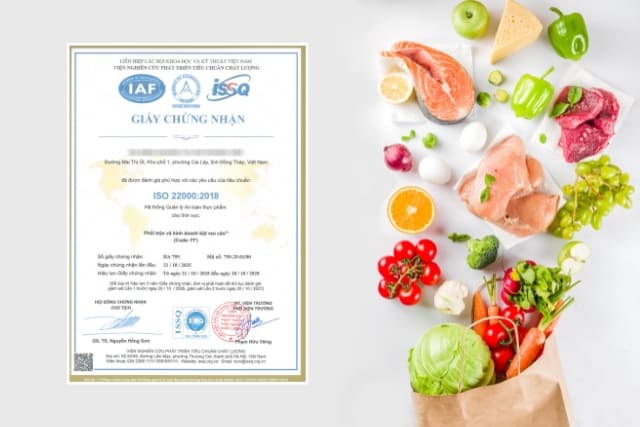
In the food industry, sustainable development is not only associated with business growth but also reflected in the ability to control risks, ensure consumer safety, and maintain market trust. ISO 22000 serves as an initial management tool that helps organizations build stable management systems to control risks throughout the supply chain.
Systematic control of food safety hazards
ISO 22000 requires organizations to comprehensively identify potential food safety hazards across the entire operational chain, from raw materials to final products. This enables food safety to be controlled from the source, creating a foundation for long-term stability and development.
Enhancing management and operational capabilities
The application of ISO 22000 helps businesses standardize processes, clearly define responsibilities, and establish effective coordination mechanisms among departments. The management system not only supports food safety control but also enhances transparency, discipline, and operational efficiency — key factors for sustainable business performance and adaptability to market changes.
Strengthening market trust and competitiveness
ISO 22000 demonstrates an organization’s commitment to food quality and safety. Implementing the standard helps build trust with customers, partners, and distribution networks, while enhancing brand image in both domestic and international markets.

ISO 22000 is designed for flexible application by all organizations directly or indirectly involved in the food chain. Its implementation enables organizations to proactively manage food safety within their operational scope while improving coordination and transparency across the supply chain.
In practice, ISO 22000 is suitable for various groups, including:
Animal feed manufacturers
Harvesters of wild animals and plants
Manufacturers of food ingredients, additives, and flavorings
Food producers and processors of all sizes
Retailers and food-related service providers (catering, cleaning, transportation, storage, distribution)
Suppliers of equipment, cleaning agents, disinfectants, packaging materials, and other food-contact materials
With its wide scope of application, ISO 22000 is an important management tool that enhances safety, connectivity, and stable development across the food chain.

Proactively control food safety hazards throughout the entire operational chain
Standardize management and operational processes
Improve product quality and consistency
Reduce errors and waste during production
Enhance trust from customers and partners
Increase market competitiveness and distribution opportunities
Provide a foundation for integration with other management systems such as ISO 9001, ISO 45001, ISO 14001
ISO 22000 not only supports effective food safety control but also contributes to sustainable and stable development in the food industry.
ISO 22000 contributes to sustainable food industry development by:
Protecting consumer health through hazard prevention
Reducing food safety risks and incidents
Encouraging responsible production and efficient resource use
Improving transparency and supply chain connectivity
Promoting continual improvement

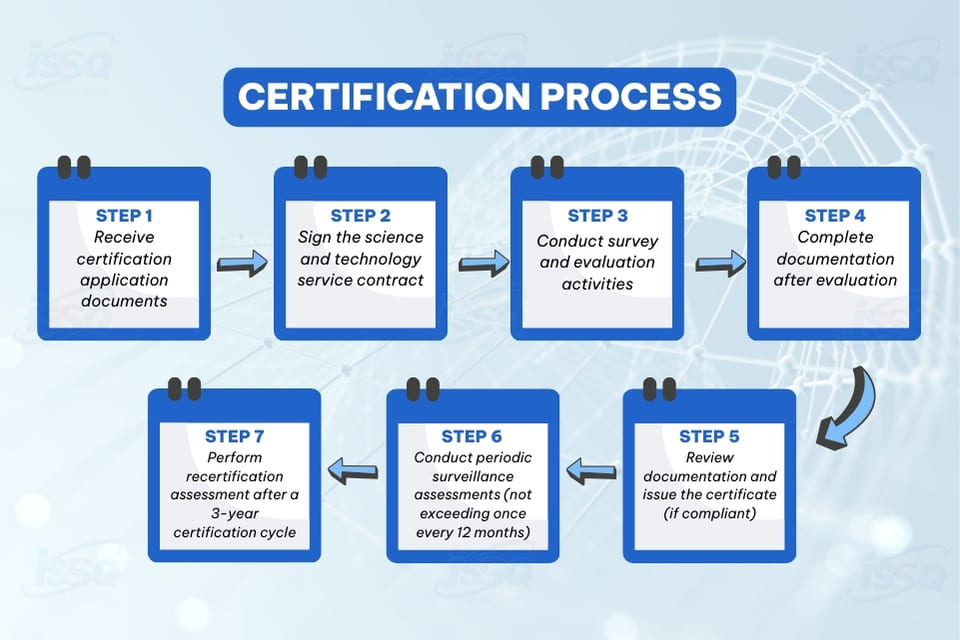
Receive certification application
Sign scientific and technological service contract
Conduct assessment and evaluation
Complete post-assessment documentation
Certification decision and issuance (if compliant)
Periodic surveillance audits (not exceeding 12 months per audit)
Recertification after a 3-year cycle
In the context of increasing emphasis on food safety, quality, and sustainability, ISO 22000 is considered a key management foundation for businesses to adopt scientific and systematic food safety control approaches.
Organizations requiring ISO 22000 certification services may contact ISSQ via hotline: (+84) 981851111 or email vienchatluong@issq.org.vn | tcvn@issq.org.vn for procedural support.
Published date: 19/12/2025


