
INSTITUTE FOR STANDARD AND QUALITY DEVELOPMENT STUDIES


19/04/2024
Environmental safety management is playing an increasingly important role in an organization’s strategic planning process. A new requirement to understand the organizational context has been established in order to identify and take advantage of opportunities for the benefit of both the organization and its environment.
The ISO 14001 standard, fully known as the Environmental Management System, is a set of standards related to environmental management issues. It provides maximum support for organizations to minimize negative environmental impacts while complying with legal requirements as well as other environmental policies.
Within the ISO 14001:2015 standard, guidance is provided on how to establish and implement the most effective environmental management system, as well as how to address environmental management aspects. The primary objective of this standard is to enhance environmental management performance within enterprises. It offers useful tools to enable cost-effective and flexible resource utilization, while reflecting the optimal operational performance of enterprises and organizations.
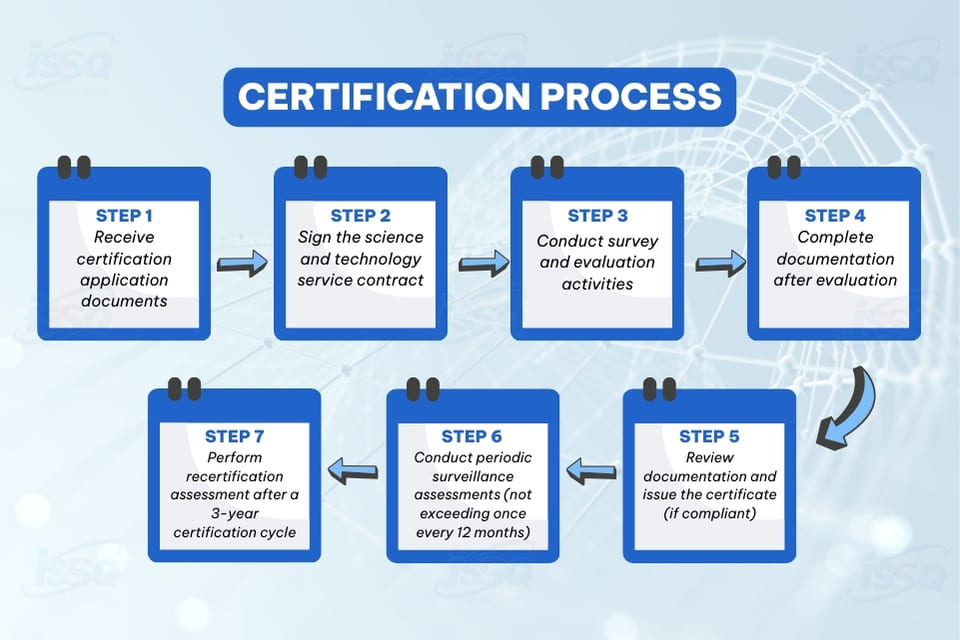
Step 1: Receive the certification application dossier
Step 2: Sign the scientific and technological service contract
Step 3: Conduct on-site survey and assessment at the enterprise
Step 4: Complete documentation after assessment
Step 5: Appraise documentation and issue certification (if compliant)
Step 6: Conduct surveillance assessment once every 12 months
Step 7: Conduct recertification assessment (certificate validity: 3 years)
From a management perspective
From a branding perspective
From a financial perspective
The above information provides an overview of ISO 14001:2015 Certification – Environmental Management System.
ISSQ Institute for Quality Development Studies is always ready to accompany companies in the period of integration and development.
Please contact the hotline: +84 981851111 or vienchatluong@issq.org.vn | tcvn@issq.org.vn. We are honored to serve our valued customers!


